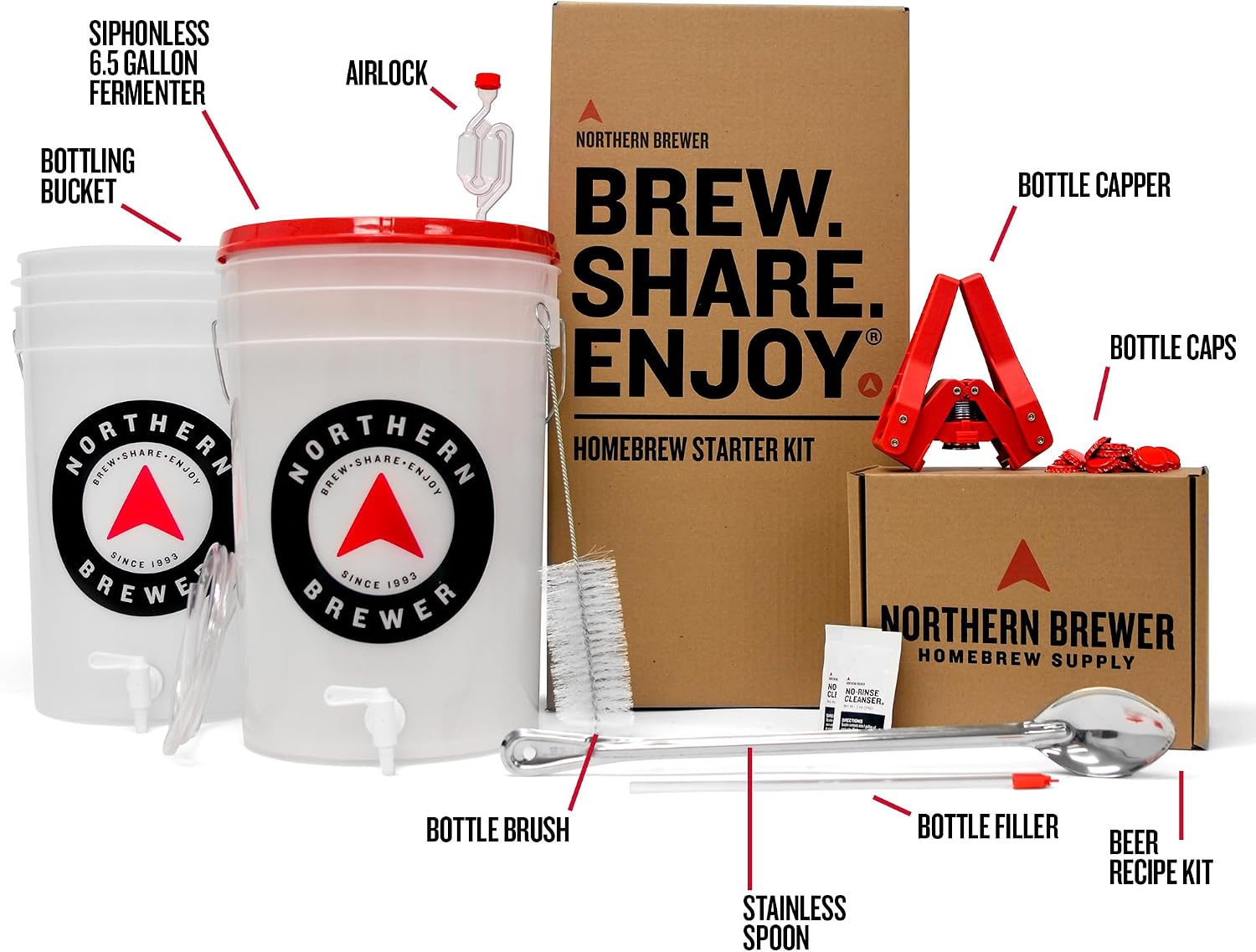
If you’ve been curious about making beer at home but aren’t sure where to start, here’s the honest truth: the barrier to entry is much lower than most people assume. Extract brewing — the method used by virtually every beginner and plenty of experienced brewers — works by skipping the most equipment-intensive step of the process. Instead of converting raw grain into fermentable sugar yourself (a process called mashing, which requires a whole separate set of gear and timing), you start with malt extract: a thick, pre-processed syrup or dry powder that already contains those sugars, ready to dissolve into hot water. Add hops for bitterness and aroma, cool it down, pitch yeast, and you’re fermenting. A good 5-gallon extract starter kit bundles everything you need to do that first brew day without a hardware store run. This guide compares the kits worth buying in 2026, names the tradeoffs honestly, and ends with a clear decision rule so you can stop second-guessing and start brewing.
What a 5-Gallon Extract Kit Actually Includes (and What It Doesn’t)
Before comparing brands, it helps to know what you’re comparing. Most kits in the $40–$120 range include some version of this core equipment stack:
- A fermentation vessel — typically a 6-gallon plastic bucket or glass carboy (a large glass jug). This is where your beer lives for one to three weeks while yeast converts sugar into alcohol.
- An airlock and stopper — a small water-filled valve that lets CO₂ escape without letting air (and bacteria) in.
- A siphon or auto-siphon — used to transfer beer between containers without disturbing the settled yeast.
- A bottle capper and caps — for sealing your finished beer into standard 12 oz bottles.
- A sanitizer packet — usually Star San or a similar no-rinse sanitizer; sanitation is the single most important variable in homebrewing, per Brew Your Own Magazine’s extract brewing fundamentals guide.
- Ingredient kits (sometimes) — many hardware-only kits are sold separately from ingredient kits; some bundles include a recipe kit with malt extract, hops, and yeast for one full batch.
What most starter kits don’t include: a brewing kettle (you need at least a 5-gallon stockpot, ideally larger), a thermometer, and bottles. Budget $20–$40 extra if you’re starting from zero kitchen equipment.
By the Numbers
| Kit Tier | Typical Price | Fermentor Type | Includes Ingredients? |
|---|---|---|---|
| Entry-level | $40–$65 | Plastic bucket | Sometimes |
| Mid-range | $70–$100 | Bucket + carboy | Usually yes (1 batch) |
| Premium | $100–$120 | Glass or better plastic | Yes, often upgraded |
The Kits Worth Knowing About in 2026
Northern Brewer Essential Brewing Starter Kit
Northern Brewer’s flagship entry kit is consistently the benchmark that other brands are measured against. It ships with a 6-gallon plastic fermenting bucket, an auto-siphon, tubing, bottle capper, bottle brush, sanitizer, and a recipe kit — typically their American Wheat or Caribou Slobber Brown Ale. Owners across aggregated reviews consistently point to two strengths: the auto-siphon is better quality than what competitors include at this price, and the step-by-step instructions are unusually clear for a beginner product.
The tradeoff is the fermentor. A plastic bucket is fine for your first few batches, but scratches over time create tiny grooves that harbor bacteria — a real concern for flavor consistency if you’re planning to brew repeatedly. Northern Brewer addresses this by offering an upgraded version with a 6-gallon glass carboy, which doesn’t scratch and is easier to inspect for cleanliness.
If you care about long-term value: the glass carboy upgrade adds roughly $20–$30 to the bundle price and is worth it if you’re planning to brew more than twice.
Per the American Homebrewers Association’s community overview, Northern Brewer is one of the most commonly cited first-kit brands among members who have been homebrewing for two or more years — which is a meaningful signal that the kit doesn’t turn people off the hobby.
Brooklyn Brew Shop Beer Making Kit
Brooklyn Brew Shop takes a different philosophical approach: their kits are built around 1-gallon batches, not 5-gallon, and they lean hard into design and gifting aesthetics. If you or someone you’re shopping for wants a brew-day experience that looks good in a small apartment kitchen and produces about eight 12 oz bottles per batch, Brooklyn Brew Shop is the clearest recommendation in that lane.
The limitation is scale. MoreBeer’s starter kit comparison guide notes that cost-per-bottle math on 1-gallon kits runs meaningfully higher than 5-gallon brewing, since most of the overhead (equipment, time, cleanup) is fixed regardless of batch size. Brooklyn Brew Shop is the right call for curiosity, gift-giving, and space-constrained brewers. It’s the wrong call if you’re trying to brew enough beer to actually drink regularly.
For the purposes of this guide focused on 5-gallon kits, Brooklyn Brew Shop earns its mention because so many buyers are choosing between these two formats. If you’re reading this as a gift buyer, a Brooklyn Brew Shop kit is lower commitment and more apartment-friendly; a Northern Brewer or Midwest Supplies kit is the right move if the recipient is serious about the hobby.
Midwest Supplies Home Brewing Starter Kit
Midwest Supplies occupies a strong mid-range position. Their standard 5-gallon kit typically includes a bucket fermentor, bottle filler (a spring-loaded wand that makes bottling dramatically less messy than a basic siphon setup), auto-siphon, tubing clamp, bottle caps, and sanitizer. Some versions ship with a recipe kit; others are hardware-only.
The standout differentiator: the bottle filler wand. Owners consistently report this single item makes the bottling session — the most tedious part of beginning homebrew — noticeably less frustrating. It’s a detail that signals Midwest Supplies has thought about the actual experience of brew day, not just the list of parts.
The weak point at this tier is that plastic bucket quality varies by production run. Craft Beer & Brewing’s overview of malt extract fermentation notes that airtight seals on cheaper buckets can be inconsistent, leading to slower or irregular fermentation — not a catastrophe, but a variable you don’t want to troubleshoot on your first batch.
Decision framing: If you’re choosing between Northern Brewer and Midwest Supplies at similar price points, Northern Brewer wins slightly on instruction quality and brand support; Midwest Supplies wins on the bottling experience. Both are solid.
Ss Brewtech Brew Bucket (Starter-Adjacent Upgrade Path)
This isn’t a beginner kit in the traditional sense — it’s a standalone fermentor, the 7-gallon stainless steel Brew Bucket, which homebrewers commonly adopt as their first real upgrade after outgrowing a plastic bucket. It’s worth including here because a meaningful number of buyers in the $300–$800 equipment tier purchase this as their second fermentor and then regret not starting with it.
Published specs put the Brew Bucket at 304 stainless steel construction with a racking port near the bottom, a flat bottom that accommodates a magnetic stir plate, and a secure tri-clamp lid. Owners in long-run reviews consistently note that the inside is easier to clean than either glass carboys or plastic buckets and that it holds temperature more stably during fermentation — a real quality variable, especially in warmer home environments.
The honest tradeoff: the Brew Bucket alone runs $150–$200 and doesn’t include any of the other starter-kit components. It makes the most sense if you’re pairing it with an ingredient-only kit from Northern Brewer or MoreBeer, you already have a kettle and thermometer, and you want your fermentor investment to last a decade rather than two years.
Anvil Foundry Starter Bundle (For the Serious First-Timer)
If you know you’re going to stick with this hobby — if you’re the kind of person who goes all-in on a new interest rather than testing slowly — the Anvil Foundry brewing ecosystem is worth examining even at the starting line. Anvil doesn’t make a traditional starter kit in the Northern Brewer mold, but their entry-level fermentor and accessories are priced to be accessible to a serious beginner.
Anvil’s 4-gallon Bucket Fermentor, specifically, is a well-regarded piece of gear: injection-molded with a wide-mouth opening, a built-in thermometer port, and a spigot positioned to minimize sediment pickup. Brew Your Own Magazine’s extract brewing fundamentals coverage has cited Anvil fermentors as a reliable step up from basic bucket setups. Pair it with a Northern Brewer or MoreBeer ingredient kit and you have a 5-gallon setup that will serve you well into intermediate all-grain brewing.
The Cost-Per-Batch Math
One number that changes how most people think about kit pricing: the ingredient kit included with most starter bundles covers exactly one batch. After that, you buy ingredient kits separately — typically $30–$50 per 5-gallon batch, depending on the style and your supplier.
At five gallons, you’re producing roughly 48 twelve-ounce bottles. At $40 per ingredient kit plus amortized equipment costs over 10 batches, your all-in cost per bottle runs around $1.20–$1.80 for mid-tier craft-equivalent beer. The American Homebrewers Association’s community overview pegs the average homebrewer’s per-batch ingredient spend in 2024–2025 at $38–$45 for extract recipes, a number that’s been stable despite input cost pressures.
The equipment cost pays itself off quickly if you brew regularly. A $100 starter kit amortized over 20 batches adds $5 per batch — essentially noise.
The Decision Rule
Here’s the if/then framework:
If you’re completely new and want to spend as little as possible to find out if you enjoy this: → Northern Brewer Essential Starter Kit, plastic bucket version. Under $65 with an ingredient kit. Enough gear to make a real 5-gallon batch, good instructions, strong brand support.
If you’re a serious beginner who wants gear that grows with you: → Northern Brewer or Midwest Supplies kit for the consumables and accessories, paired with an Ss Brewtech Brew Bucket or Anvil Bucket Fermentor instead of the included bucket. Spend $180–$220 total and your fermentor is still in rotation five years from now.
If you’re buying as a gift for someone in a small space or just curious: → Brooklyn Brew Shop 1-gallon kit. Lower commitment, better presentation, produces real beer.
If you already know you’re going all-in on all-grain brewing within 12 months: → Skip the traditional starter kit entirely. Buy ingredient kits loose, invest that $80–$100 in a better fermentor, and treat your kettle and thermometer as the actual foundation of your setup.
The beer is forgiving. The yeast wants to work. What a good starter kit actually buys you isn’t equipment — it’s a first brew day that goes smoothly enough that you want to do it again.