If you’ve ever wanted to brew a proper all-grain beer at home — the kind where you start with raw malted barley and finish with a sugar-rich liquid ready to ferment, without juggling a separate burner, kettle, and mash tun — an all-in-one electric brewing system is the gear that makes it practical. Think of it as a single, programmable vessel that heats your water, steeps your grain (the “mash”), and then boils the resulting liquid (the “wort”) all in one place. The Grainfather G30 has been one of the most recognized names in that category for several years, landing in the sweet spot between entry-level homebrewing and full commercial scale. Now there’s a third-generation refresh — the G30 Gen3 — alongside a 220V variant that looks nearly identical on the shelf but behaves meaningfully differently in your garage. This article breaks down exactly what changed, where the voltage version earns its price premium, and how to make the call.
| EDITOR'S PICKG30 New Version 3 Gen3 110V - P… | Mid-tierThe Grainfather Stainless Steel… | Budget pick[Grainfather Conical Bundle](https://www.amazon.com/dp/B074V9M8Y2?tag=greenflower20-20) | |
|---|---|---|---|
| Capacity | 8 US Gal | — | — |
| Material | Stainless Steel 304 | Stainless Steel | — |
| Voltage | 110V | — | — |
| Bundle | ✗ | ✗ | ✓ |
| Price | $1,098.98 | $995.00 | $704.00 |
| See on Amazon → | See on Amazon → | See on Amazon → |
What Actually Changed in the Gen3 Refresh
The Gen3 didn’t reinvent the G30 — and that’s largely fine, because the G30’s core architecture wasn’t broken. What Grainfather targeted in this revision was the friction that owners of the earlier G30 and G30v2 raised consistently across long-run reviews: temperature ramp time, connectivity stability, and the pump’s handling of thicker, high-adjunct mashes.
Per Grainfather’s published Gen3 product specifications, the heating element on the standard 110V model remains rated at 2,000W — the same as its predecessor. That ceiling is a hard constraint of North American residential electrical infrastructure; most standard 15A circuits top out well before you can push more wattage safely. The element geometry has been revised, however, and the recirculation pump has been upgraded to a brushless motor variant that Grainfather rates for improved longevity and consistent flow at lower revs. That matters when you’re mashing a 15-lb grain bill with a significant percentage of wheat or oats, which are notorious for sluggish lautering — the process of separating sweet liquid from spent grain.
The control board and companion app have been rebuilt. Owners of earlier-generation Grainfather systems will recognize the frustration of Bluetooth dropouts mid-brew, a recurring theme in owner reports discussed in Brulosophy’s all-in-one system long-run owner reports roundup (brulosophy.com). The Gen3 moves to dual Bluetooth/Wi-Fi connectivity, meaning your phone no longer needs to stay within arm’s reach of the unit to hold a stable connection. For a brewer running a four-hour session in a garage, that’s a quality-of-life change that actually matters.
The vessel itself — 30-liter capacity, stainless steel, roughly capable of producing 7–8 gallons of pre-boil wort for a standard American or European ale — is dimensionally unchanged. Existing G30 accessories, grain pipes, and counterflow chillers carry forward without compatibility issues, per Grainfather’s accessory documentation.
The 220V Variant: Why Voltage Is the Real Story
Here’s where the G30 line gets genuinely interesting for the serious hobbyist or aspiring nano-brewer: the G30v3 220V is not simply a G30 Gen3 with a different plug. It runs at 3,000W — a 50% power increase — which changes the machine’s behavior in ways that compound across an entire brew day.
By the numbers:
| Spec | G30 Gen3 (110V) | G30v3 220V |
|---|---|---|
| Heating element | 2,000W | 3,000W |
| Typical strike water heat-up (20L, 60°F → 155°F) | ~35–40 min | ~22–25 min |
| Circuit requirement | Standard 15A/120V | Dedicated 240V/20A |
| MSRP (May 2026) | ~$899 | ~$1,049 |
Heat-up estimates are based on manufacturer-published wattage and standard thermal calculation; actual times vary by starting water temperature and ambient conditions.
The 220V advantage isn’t cosmetic. Brew Your Own magazine’s 2025 all-in-one electric brewing system buyer’s guide (byo.com) notes that wattage directly governs how aggressively a system can hit and hold mash temperatures — especially in colder ambient conditions like an uninsulated garage in winter. At 2,000W, the G30 Gen3 can struggle to sustain a vigorous rolling boil in cooler environments with a full grain bill. At 3,000W, that problem largely disappears.
The tradeoff is your electrical panel. The 220V model requires a dedicated 240V/20A circuit — the same type used by a clothes dryer or a window air conditioner. If your garage or brewery space doesn’t have one, you’re looking at an electrician visit. In most U.S. markets in mid-2026, a new dedicated 240V circuit runs $200–$500 depending on distance from the panel and local labor rates. That cost needs to be in your budget math before the 220V model looks cheaper on a per-session basis.
The Homebrewers Association’s electric brewing equipment overview (homebrewersassociation.org) notes that 240V systems are increasingly the baseline expectation for serious homebrewers who batch four or more times per month, precisely because the time savings compound. If the 220V model shaves 15–18 minutes off heat-up and recovery-to-boil time each session, that’s an hour or more reclaimed per month for a regular brewer.
Head-to-Head: Where Each Model Has the Edge
The G30 Gen3 (110V): Best for Flexible Spaces and Lighter Grain Bills
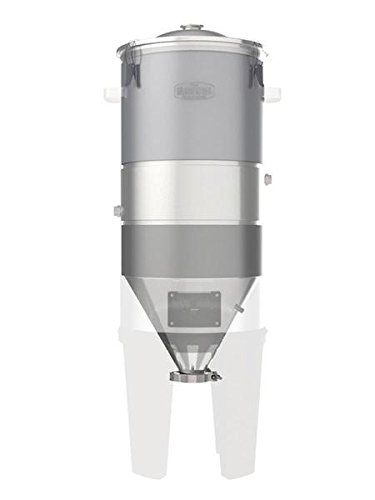
Grainfather
$704.00
In stock on Amazon
Check price on AmazonThe 110V model wins if you’re renting, or your brewing space doesn’t have — and can’t easily get — a 240V outlet. It plugs into any standard kitchen or garage outlet, removing a real installation barrier. It’s also the right call if portability matters: you can take a 110V unit to a friend’s garage, a homebrew club meeting, or a vacation property without logistical planning.
The 110V also makes sense when your typical batch sizes run toward the lower end of the G30’s range. A 10–12 lb grain bill for a session ale or a pale lager doesn’t stress the 2,000W element the same way a 17–18 lb double IPA grain bill does. Lighter-gravity, smaller-grain-bill brews are where the 110V’s wattage limitations show the least friction.
MoreBeer’s editorial content on Grainfather system comparisons (morebeer.com/content) echoes this framing: for brewers doing 4–6 gallon finished batches at moderate gravities (roughly 1.040–1.065 original gravity), the 110V Gen3 is competent and well-matched to the task.
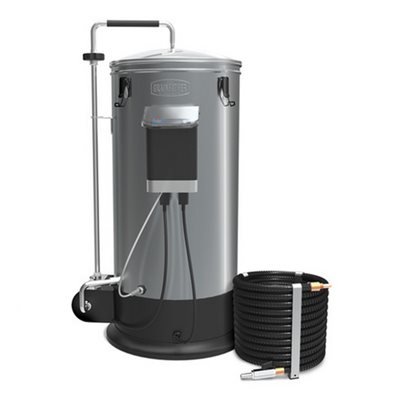
The
$995.00
In stock on Amazon
Check price on AmazonThe G30v3 220V: Best for High-Gravity Brews and Cold-Climate Garages
The
$995.00
In stock on Amazon
Check price on AmazonAt 3,000W, the 220V model sustains a harder boil — relevant not just for time savings but for wort character. A vigorous boil drives off certain volatile compounds more effectively than a lazy, rolling boil. Chief among these is DMS (dimethyl sulfide), which gives beer an unwanted cooked-corn flavor when it isn’t driven off during the boil. That’s a beer quality argument, not just a convenience argument.
If you’re on a trajectory toward nano-brewing or running a small pilot system, the 220V model is the one that will feel less like a compromise over time. Brulosophy’s long-run owner report roundup (brulosophy.com) notes that brewers who upgraded from 110V to 220V systems consistently cited “boil vigor” and “heat recovery after cold water additions” as the tangible improvements they felt most in the finished product.
The 220V model is also the sensible pick if you’re frequently mashing high-adjunct beers — hazy IPAs with heavy oat additions, wheat beers, or rye-forward styles — where the upgraded pump and additional thermal headroom work together to prevent stuck mashes and temperature sag.

G30
$1,098.98
In stock on Amazon
Check price on AmazonThe Competitive Field: Where the G30 Fits Against Alternatives
G30
$1,098.98
In stock on Amazon
Check price on AmazonThe G30 Gen3 doesn’t exist in isolation. The Anvil Foundry 10.5-gallon system remains a frequently-cited alternative at a similar price tier, offering a 120V/240V dual-voltage element that sidesteps the “which version do I buy?” question — at the cost of a slightly larger footprint. The Robobrew/Brewzilla line from KegLand occupies a lower price band and has a committed user base; Brew Your Own magazine’s 2025 all-in-one buyer’s guide (byo.com) identifies it as the value play for brewers who want to get into all-grain without committing to the Grainfather ecosystem.
Where the G30 earns its position is ecosystem maturity. Counterflow chillers, conical fermenter pairings, and the app-controlled automation stack are more developed on the Grainfather platform than on most competitors in this size class. For brewers who want a single-brand system that scales with accessories over time, that coherence has real value.
G30
$1,098.98
In stock on Amazon
Check price on AmazonThe Price-to-Value Decision Frame
At roughly $150 MSRP delta between the two models — plus the electrical installation cost, if applicable — the 220V premium is not a trivial question. Here’s how to frame it honestly:
If you already have a 240V circuit in your brewing space, the 220V model is the clear recommendation. The per-session time savings, improved boil character, and long-run reliability advantages make the price gap easy to justify across even a single year of regular brewing.
If you need to install a new circuit, add $200–$500 to the 220V’s total cost. At the high end of that range, you’re looking at a roughly $650 all-in premium over the 110V model on day one. That math only works if you’re brewing frequently enough — call it 8–12 or more sessions per year — and at grain bills and gravity levels where the wattage difference is actually limiting you.
If you’re a weekly or twice-monthly brewer pushing high-gravity, high-adjunct recipes, the 220V math pays out relatively quickly. If you’re a weekend hobbyist brewing session ales twice a month, the G30 Gen3 at 110V gets the job done without the installation headache or upfront cost.
The Homebrewers Association’s electric brewing equipment overview (homebrewersassociation.org) frames the 240V upgrade decision similarly for homebrewers evaluating the long-term cost of their setup: infrastructure investment only makes economic sense when matched to brewing volume and recipe ambition.
Practical Setup Considerations
Before you pull the trigger on either model, a few setup factors are worth verifying:
Water source: Both models assume access to reasonably soft, low-mineral tap water or the ability to adjust your brewing water chemistry. Hard water can leave mineral scale on heating elements over time, a maintenance concern that’s worth reading up on in Brew Your Own magazine’s ongoing equipment care coverage (byo.com).
Chilling: Neither G30 variant includes a wort chiller. You’ll need to budget for a counterflow or immersion chiller separately, or plan to use Grainfather’s own counterflow chiller accessory, which is designed to connect directly to the pump port.
Fermentation: The G30 gets your wort to pitching temperature, but fermentation temperature control is a separate discipline. If you’re serious enough to buy a G30, you’re likely serious enough to want a temperature-controlled fermentation chamber — a chest freezer with an inkbird controller is the classic homebrew solution, and it pairs with any fermenter you choose.
The Bottom Line
If you have a 240V outlet available (or can install one for under $250): Buy the G30v3 220V. The wattage is the machine’s personality, and 3,000W is meaningfully better for the kind of brewer who invests $1,000 or more in a single-vessel system.
If you’re renting, space-constrained, or brew lighter-gravity beers twice a month: The G30 Gen3 at 110V is a genuinely refined machine — better connectivity, better pump, better than the version it replaced — and it requires zero electrical infrastructure investment beyond a standard outlet.
If you’re seriously eyeing a nano-brewery transition: Neither G30 variant replaces a dedicated commercial-scale brewhouse, but the 220V model’s vigor and process consistency will keep your recipe development credible at the pilot-batch stage. Pair it with a glycol-ready unitank and you have a legitimate small-batch development rig.
The Gen3 refresh didn’t overhaul the G30 — it tightened the screws on the things that mattered most to real-world owners. For the brewer ready to move from extract brewing (where pre-made malt syrup does the sugar-conversion work) into full all-grain territory, either version of the G30 is a serious, capable first step. The voltage question is the only meaningful decision left.